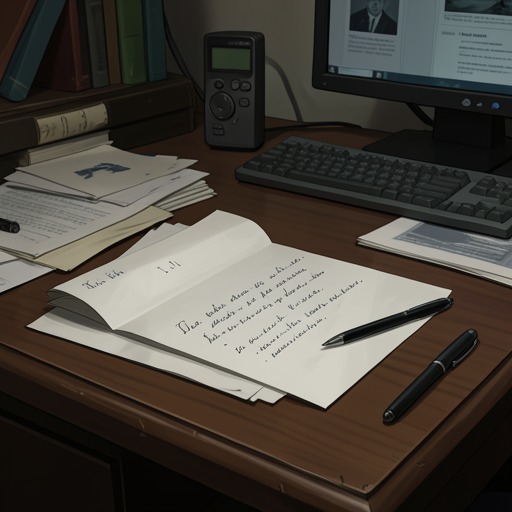
Important things are hidden in important places
Even If This Love Disappears From the World Tonight“Important things are hidden in important places” is both a private message and a principle of the story’s memory plot. Its force emerges when a reminder concealed on the back of a note and drawings hidden behind a bookcase outlast the effort to remove Tooru Kamiya from Maori Hino’s records. What first sounds like a metaphor resolves into a practical instruction: Maori has placed something she wants her future self to find where she once hid things that mattered. The phrase links objects and spaces to a continuing relationship with someone she has forgotten, and makes rediscovery possible without making it automatic.
The note and its intended reader
After Tooru’s death, his sister and Izumi Wataya undertake to remove him from Maori’s journal and binder. The task is not simply to delete a name: the records are the means by which Maori, living with amnesia, learns about her days and herself. Tooru’s sister offers to type the journals and binder into a computer and repair the passages altered to remove him. Later, Izumi gathers the physical binder and journals, transfers the edited digital material to Maori’s laptop, and replaces her old phone so that photographs, videos, messages, and conversations will not reveal Tooru. The plan is comprehensive, but it cannot account for every trace.
While replacing Maori’s handwritten reminder notes with typed sheets, Izumi finds a sticky note on the back of one. It reads, “Even if I recover, always remember Tooru Kamiya. The important things will always be in an important place.” The position matters: the message is hidden from ordinary view, yet placed where Maori might see it when taking down the note. Izumi suspects that Maori prepared it for the possibility of recovering from amnesia, though she cannot know whether Maori understood the concealment being planned or simply wanted to preserve her feelings for Tooru. The instruction is therefore at once deliberate and partly opaque: its author seems to have anticipated a future self who would need help, but the circumstances of that help remain uncertain.
From metaphor to a physical hiding place
The phrase becomes clearer when Maori later finds a sketchbook behind her bookcase and asks Izumi why she hid the drawings. She recalls that, as a child, she began hiding things there because her overprotective father used to enter her room and read the group journal she kept with friends. He eventually stopped, and she forgot the hiding place. The sketchbook’s location is thus not an arbitrary secret compartment: it belongs to a remembered habit formed in response to an invasion of privacy, then lost from conscious recollection.
Izumi connects this history to the note on its hidden side. Maori’s words about important things in an important place are not merely figurative encouragement. The important place is the familiar hiding spot behind the bookcase; the important thing is Tooru, whom Maori wanted her recovered self not to forget. The concealed note and concealed sketchbook echo one another. Each turns a private act of hiding into a message across time, though the note states the intention while the sketchbook supplies the tangible images that make it harder to dismiss.
Records, erasure, and what remains
The motif gains weight because the people around Maori are actively editing the evidence of her relationship. Tooru’s sister can reconstruct altered journal passages on a computer, create entries for the days after his death, and falsify file timestamps; Izumi can replace phone data and make a new messaging account appear to have lost its history in a transfer. These interventions seek to protect Maori from the risk of depression associated with her condition, but they also leave her with a version of the past from which Tooru has been removed. The physical reminder’s reverse and the forgotten hiding place resist that clean account—not by preserving an untouched archive, but by leaving clues that the editors did not know to remove.
The story repeatedly treats memory as something carried through different media. Maori’s binder, journal, phone, and laptop can organize or reproduce information; photographs and videos can show Tooru; an audio file extracted from a video can bring back the circumstances of a bicycle ride through the sounds of rattling, wind, and Maori’s delighted squeals. The sketchbook does something different: it holds drawings that Maori later recognizes as pictures of Tooru as she remembers him. No single medium guarantees recovery, and even a clue can be misread or hidden again. The phrase gives these objects a shared logic: they are not interchangeable containers but situated invitations to recognize what mattered.
Remembering without surrendering the present
When Izumi first finds the note, she decides to preserve it by attaching it to the back of one of the replacement sheets. Her choice keeps the message inside the very system being rewritten, allowing Maori to encounter it later without undoing the protective plan at once. Izumi initially withholds the truth about Tooru even after Maori recovers, telling her only that she saw him a few times at the library during summer break in high school. But the hidden sketchbook makes that account harder to sustain. Maori notices that she had hidden the drawings and presses Izumi to say whether she is concealing something. The old hiding place does not itself explain everything; it makes the gap in the official version visible.
Maori eventually chooses to pursue the memories rather than accept forgetting as the only safe course. She worries that photographs and videos might overwrite the image of Tooru she already carries, but agrees to listen to his voice. The recording returns her to the day she insisted that they ride a bicycle together. Later, she tells Tooru’s sister that if everyone else is gradually forgetting him, she wants to gradually remember and recover what is important to her. His sister warns her not to become captive to the past or neglect her own life, and Maori promises to keep living as well as remembering. The phrase’s importance lies in holding those aims together: the past is worth seeking, but the hidden object is a route toward remembrance, not an order to stop moving forward.
Three years later, Maori is still trying to recover Tooru through her journals, Izumi’s stories, visits to places they went, and attempts to repeat things they did. The process is neither quick nor guaranteed. At the cherry-blossom park, Izumi sees in Maori’s sketchbook drawings of Tooru she has never seen before, rendered as Maori now remembers him. Maori is looking toward the row of cherry trees, absorbed in the effort to recall. She says she has remembered something else, while acknowledging that she has not remembered everything. The drawings give visible form to a memory returning from within, rather than simply reproducing an image supplied by another person.
The maxim’s final meaning is therefore not that every lost memory can be recovered by searching the right drawer. The note and sketchbook preserve opportunities, while Maori’s choice, attention, and gradual effort make those opportunities meaningful. In the end, she says that Tooru’s memories sleep in her body and heart, and that remembering allows them to continue living together. The hidden place has done its work: not restoring an intact past, but helping Maori find a way to hold love and loss, seek what remains, and still reach toward future happiness.